
Your Clients' Data Deserves More Than a Privacy Statement
Personal injury law firms work with some of the most sensitive information imaginable — medical records, diagnoses, treatment histories, billing records, deposition transcripts, settlement information, and personally identifiable information.
Before they send a single file, they deserve a clear, direct answer to one question: how exactly is that data protected?
This page lays out FactAssess' approach to HIPAA compliance, information security management, data handling practices, and confidentiality policy — the same standards we hold ourselves to on every AI output audit, case review, and drafting engagement we take on.
HIPAA Compliance
Personal injury case files routinely contain Protected Health Information (PHI) — diagnoses, treatment histories, provider records — which means HIPAA compliance isn't optional for any vendor touching that data, including AI output audit and medical record review providers based outside the United States.
FactAssess' HIPAA-aligned practices include:
✓
A documented Security Risk Assessment covering administrative, physical, and technical safeguards for all PHI handled during medical chronology, demand letter, and case review work
✓
Business Associate Agreements (BAAs) available for every client engagement involving PHI, as required under HIPAA for any vendor processing protected health information on a covered entity's behalf
✓
Role-based access controls limiting PHI exposure to only the reviewers actively assigned to a given case file
✓
Documented breach notification protocols and incident response procedures
✓
Ongoing staff training on PHI handling, HIPAA requirements, and secure data practices for all reviewers working with medical-legal documentation

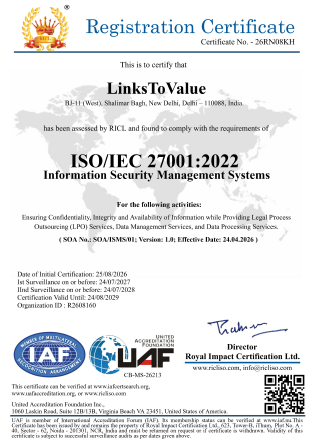
ISO 27001:2022 — Information Security Management
ISO 27001:2022 is the current international standard for information security management systems (ISMS), covering how an organization identifies, manages, and reduces information security risk across people, processes, and technology.
FactAssess' information security program is structured around ISO 27001:2022 principles, including:
✓
Formal risk assessment and risk treatment processes applied to all systems handling client and PHI data
✓
Documented access control policies governing who can view, edit, or transmit sensitive case and medical record data
✓
Encryption of data in transit and at rest across our document handling and review infrastructure
✓
Regular internal security reviews and continuous improvement of our information security management system
Data Handling & Security Practices
Beyond formal audit, day-to-day data handling practices are where security actually gets tested. Here's how case files, medical records, and AI-generated drafts move through our process:
✓
Secure intake: All documents are submitted through an encrypted, access-controlled client portal — never through unsecured email or unencrypted file transfer
✓
Encrypted storage and transmission: Data at rest and in transit is encrypted throughout the review, audit, and drafting process
✓
Access controls: Reviewers only access the specific case files assigned to them, with activity logging across our systems
✓
Retention and disposal policies: Client data is retained only as long as necessary for the engagement and securely disposed of according to documented retention schedules
✓
Backup, Availability & Recovery: Appropriate backup, business-continuity, and recovery practices help protect information availability and support operational resilience
Confidentiality Policies
Every engagement is governed by strict confidentiality obligations, independent of and in addition to HIPAA-specific requirements:
✓
Mutual confidentiality and non-disclosure terms are standard in every client agreement
✓
Case-specific information is never shared, referenced, or reused across client engagements
✓
Internal staff confidentiality agreements apply to every reviewer, analyst, and team member with access to client data
✓
Client-specific data segregation practices prevent cross-contamination between different firms' case files
How We Handle Your Data
Our Compliance Roadmap
Compliance isn't a one-time achievement — it's an ongoing commitment we continue to build on as our AI output audit services scale. Current and upcoming priorities include:
Milestone 1: HIPAA Compliance — Completed August 2026
Milestone 2: ISO 27001:2022 certification — Completed August 2026
Milestone 3: SOC 2 Type II attestation — Target December 2026
Security questions shouldn't slow down a decision. Ask us directly.
Our Services


About Us
Get in Touch with Us!
© 2026 FactAssess. All rights reserved. Privacy Policy